Rankings / Data + DevTools / NautilusTrader
NautilusTrader logo

Data + DevTools · Open-source trading engine

NautilusTrader

Open-source Rust and Python engine to backtest and run live trading strategies on one codebase

Paid from—
Free creditYes
Visit NautilusTrader

Core engine is free and open source. Paid Pro tiers are limited by number of live nodes; no prices published as of 21 Nov 2026. As listed on 21 Nov 2026.

Paid fromNot…Core engine is free and open…
Free creditYesOpen-source engine is free under…
DeliveryAPISelf-hosted library
Markets9Stocks, Futures, Options…
Venues—21 integrations listed
Founded2015Sydney

Overview

NautilusTrader is an open-source trading engine from Nautech Systems of Sydney. A Rust core runs the event loop, and strategies are written in Python or Rust. The pitch is one codebase for research, backtesting and live trading, with no rewrite when a strategy goes live.

It is a library you run yourself, not a data feed. It loads market data into a Parquet catalog and connects to venues and vendors such as Databento, Tardis and Interactive Brokers through adapters. A hosted Pro service and Cloud platform are announced but not yet priced.

Good to know

  • It supplies no market data of its own. You pay your data vendor separately and load the data into the catalog.
  • The 2.0 line is still release candidates: the latest, 2.0.0rc9, is dated 10 Nov 2026. PyPI's latest stable is 1.231.0 (2 Aug 2026), and installing 2.x needs pip's --pre flag.
  • Python version support differs between pages (docs say 3.13 or 3.14 for install; the repo README lists 3.13-3.15; PyPI 1.231.0 lists 3.12-3.14), so check before installing.
  • Pro, Cloud and the dashboard are not generally available and show no prices. The LGPL-3.0 license and a trademark policy limit use of the name and logo by third-party projects.

Latest news

10 Nov 20262.0.0rc9 adds Kalshi, FinFeed, Python 3.15Pre-release also adds Polymarket Protocol V2 and removes the Python Redis and Postgres cache database classes.
28 Oct 20262.0.0rc8: batched data subscriptionsAdds gzip for buffered HTTP requests and Hyperliquid scheduled cancellation, and removes Cap'n Proto codecs (GitHub timestamp shows 29 Oct).
15 Oct 20262.0.0rc7 drops Python 3.12Adds negative-price futures and calendar-based timers and bars (from release notes summary).
4 Oct 2026BitMEX adapter removed; Parquet catalog overhauled2.0.0rc6 removes the BitMEX adapter and reworks the Parquet catalog and streaming (GitHub lists 5 Oct).
15 Sep 20262.0.0rc5: typed external MessageBus streamingAlso a breaking renumbering of TradingState (from release notes summary).
20 Aug 20262.0.0rc3 removes the Cython v1 packageAdds dead-peer detection and TCP keepalive; v1 now gets only critical security backports.
2 Aug 20261.231.0: last planned 1.x releaseLatest stable on PyPI as of 21 Nov 2026; announces the cutover to the Rust-native v2 runtime.
2 Apr 2026Blog: Clocks and Timers in NautilusTraderEngineering post on timers; the blog lists only two posts, this and the March 2026 founder post.

Screens

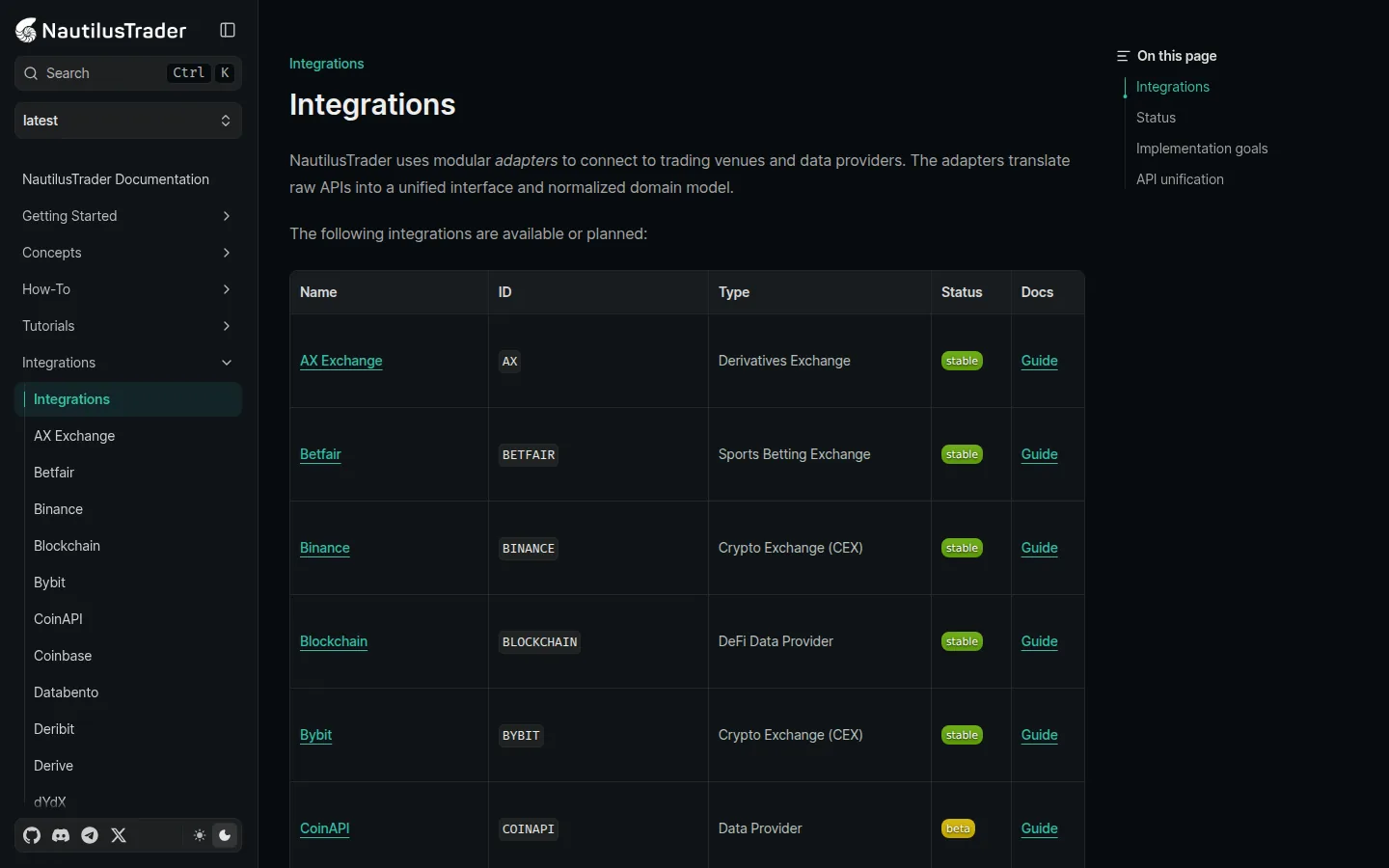
List of 21 supported venues, brokers and data providers with status
List of 21 supported venues, brokers…nautilustrader.io, 21 Nov 2026
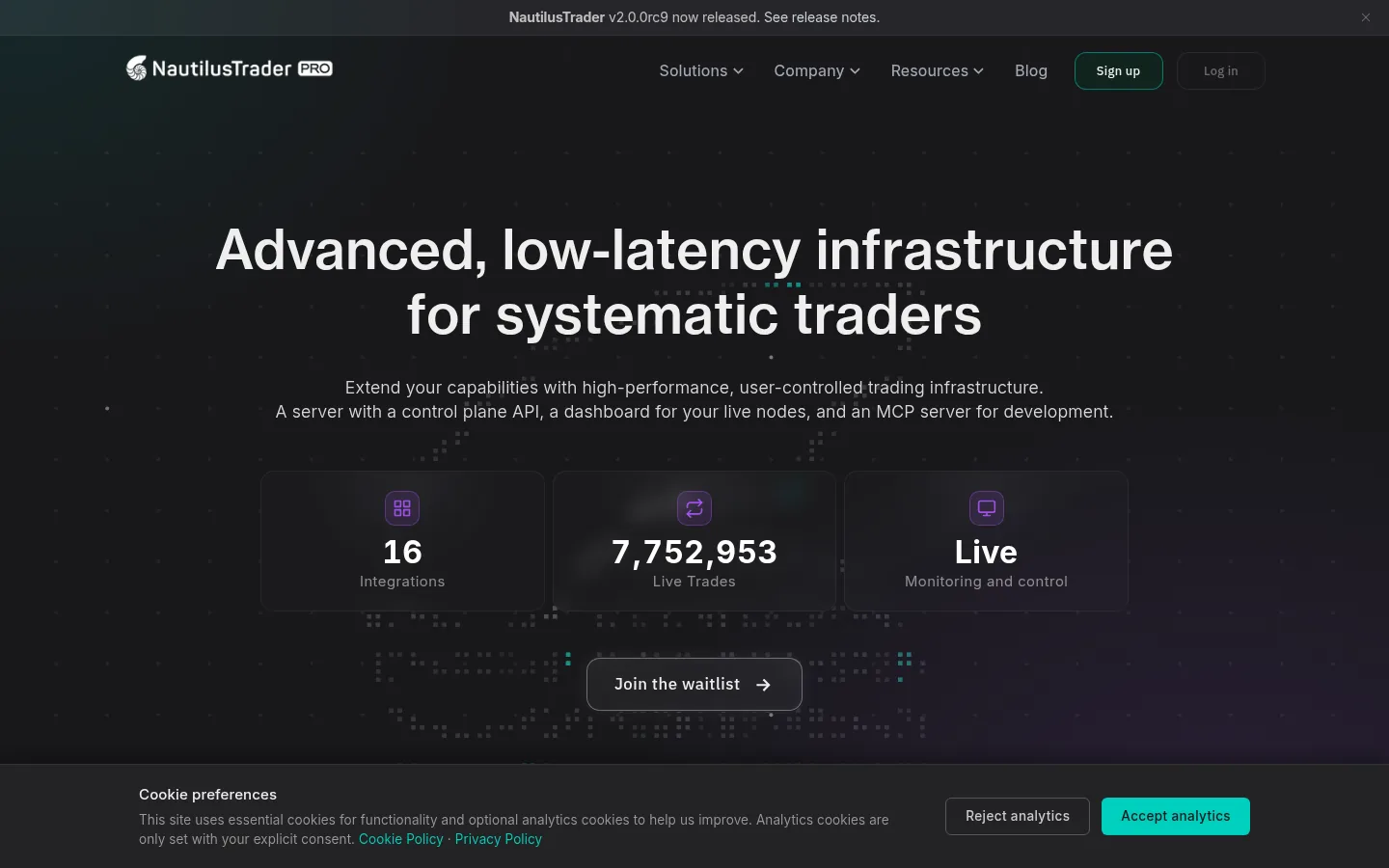
Pro tiers, node limits and dashboard mock-up
Pro tiers, node limits and dashboard…

Pricing

FreeOpen SourceFree onceFull trading engine on GitHub under LGPL-3.0; badge 'Available'

Core engine is free and open source. Paid Pro tiers are limited by number of live nodes; no prices published as of 21 Nov 2026. Free use: Yes (Open-source engine is free under LGPL-3.0. Pro (waitlist) free plan monitors and controls one NautilusTrader node. Data vendors charge separately.). Prices as listed on 21 Nov 2026.

What you get

Backtest-live parity

The same strategy code runs in simulation and in production on shared engine semantics.

Rust-native core

Core components are written in Rust, with a Python strategy API and the option of pure Rust systems.

Nanosecond simulation

Event-driven backtests at nanosecond resolution with configurable fill, fee, latency and order book models.

Order book depth

The simulated exchange accepts L1, L2 and L3 book data and supports ten order types.

Parquet data catalog

Stores market data as Parquet (Arrow record batches) for replay, research and backtesting.

Rich data types

Built-in types include order book deltas and depth, quotes, trades, bars, mark and index prices, funding rates and option greeks.

Bar aggregation

18 aggregation methods including tick, volume, value, imbalance, runs, Renko and time bars.

Advanced orders

Post-only, reduce-only, iceberg, OCO, OUO and OTO orders with IOC, FOK, GTC, GTD and DAY time in force.

Multi-venue adapters

Modular adapters connect brokers, exchanges and data vendors to the same engine.

Data coverage

NameKindNote
OrderBookDelta / DepthSchemaL3 MBO, L2 MBP and L1 book data; variable-depth snapshots
QuoteTick / TradeTickSchemaTop-of-book quotes and trades
BarSchema18 aggregation methods, internal or external
MarkPrice / IndexPrice / FundingRateSchemaDerivatives reference data
OptionGreeksSchemaOption greeks data type
Parquet catalogDatasetLocal store for vendor and custom data
DatabentoDatasetData provider adapter, stable
TardisDatasetCrypto data provider adapter, stable
CoinAPIDatasetData provider adapter, beta
FinFeedDatasetPrediction-market data adapter, beta
Interactive BrokersVenueMulti-venue brokerage adapter, stable
Binance, Bybit, OKX, Coinbase, KrakenVenueCrypto exchange adapters, stable

21 integrations listed (18 stable, 3 beta): venues and brokers plus data providers Databento, Tardis, CoinAPI, FinFeed. It brings no data of its own, so history depth depends on the vendor you connect.

Works with

NameNote
DatabentoHistorical and live market data adapter
TardisCrypto historical data adapter
CoinAPIData adapter, beta
Interactive BrokersBrokerage for stocks, futures, options and FX
Binance, Bybit, OKX, Coinbase, Kraken, DeribitCentralised crypto exchanges
Hyperliquid, dYdX, Lighter, DeriveDecentralised exchanges
Betfair, Polymarket, KalshiBetting and prediction markets (Kalshi in beta)
AX ExchangeDerivatives exchange
RedisOptional state persistence
JupyterLab (Docker)Official image for research

History

10 Nov 20262.0.0rc9 released: Python 3.15 support, new Kalshi and FinFeed adapters, Polymarket Protocol V2
4 Oct 20262.0.0rc6 removes the BitMEX adapter and overhauls the Parquet catalog and streaming (GitHub lists 5 Oct)
20 Aug 20262.0.0rc3 removes the legacy Cython v1 package (release notes date; GitHub may show 21 Aug)
2 Aug 20261.231.0 released, described as the last planned 1.x release on the Cython core (from release notes summary)
13 Apr 2026Trademark policy last updated: name and logo restricted for third-party projects
19 Mar 2026Founder post 'Why NautilusTrader Exists' announces NautilusTrader Pro and Nautilus Cloud as future offerings
12 Feb 2026Open-source licensing policy and legal disclosures published (version 1.1); says the core repo is intended to stay open source
25 Jun 2018First commit in the repository, by Chris Sellers (reported by a third-party code-history write-up)
2015Nautech Systems founded (company's own statement)

Trader reviews

How we score →
Score—

No reviews on Fintech Rankings yet. Be the first: we read every review before it appears.

Write the first review
What the score will weigh
Data quality35%
Trader reviews25%
Coverage20%
Price20%

Questions

How much does NautilusTrader cost?

The engine is free under LGPL-3.0. Pro and Cloud have no published prices and are on a waitlist or in development as of 21 Nov 2026.

Can I use it for free?

Yes, the open-source engine is free to use. Pro's free plan lets you monitor and control one NautilusTrader node. You still pay any data vendor or broker you connect.

Which markets and venues does it cover?

Its docs list 21 integrations, including Binance, Bybit, OKX, Coinbase, Kraken, Hyperliquid, dYdX, Interactive Brokers, Betfair, Polymarket and Kalshi, plus data vendors Databento, Tardis and CoinAPI.

How much history does it have?

It holds none itself. History depth comes from the data vendor you load into its Parquet catalog; no depth figure is stated on its pages.

Is it historical, live or both?

Both. The same strategy code runs in nanosecond-resolution backtests and live with connected venues.

Can I use it commercially or redistribute it?

The code is LGPL-3.0-or-later, which allows use under that license's terms. The name and logo are trademarked; third-party projects must follow the trademark policy and logo use needs written permission.


Data + DevTools

Data + DevTools · Open-source trading engine

NautilusTrader

Open-source Rust and Python engine to backtest and run live trading strategies on one codebase

Paid from—
Free creditYes

Core engine is free and open source. Paid Pro tiers are limited by number of live nodes; no prices published as of 21 Nov 2026. As listed on 21 Nov 2026.

Key facts

Paid fromNot…Core engine is free and open…
Free creditYesOpen-source engine is free under…
DeliveryAPISelf-hosted library
Markets9Stocks, Futures, Options…
Venues—21 integrations listed
Founded2015Sydney

Overview

NautilusTrader is an open-source trading engine from Nautech Systems of Sydney. A Rust core runs the event loop, and strategies are written in Python or Rust. The pitch is one codebase for research, backtesting and live trading, with no rewrite when a strategy goes live.

It is a library you run yourself, not a data feed. It loads market data into a Parquet catalog and connects to venues and vendors such as Databento, Tardis and Interactive Brokers through adapters. A hosted Pro service and Cloud platform are announced but not yet priced.

Good to know

  • It supplies no market data of its own. You pay your data vendor separately and load the data into the catalog.
  • The 2.0 line is still release candidates: the latest, 2.0.0rc9, is dated 10 Nov 2026. PyPI's latest stable is 1.231.0 (2 Aug 2026), and installing 2.x needs pip's --pre flag.
  • Python version support differs between pages (docs say 3.13 or 3.14 for install; the repo README lists 3.13-3.15; PyPI 1.231.0 lists 3.12-3.14), so check before installing.
  • Pro, Cloud and the dashboard are not generally available and show no prices. The LGPL-3.0 license and a trademark policy limit use of the name and logo by third-party projects.

Latest news

8
10 Nov 2026

2.0.0rc9 adds Kalshi, FinFeed, Python 3.15

Pre-release also adds Polymarket Protocol V2 and removes the Python Redis and Postgres cache database classes.

28 Oct 2026

2.0.0rc8: batched data subscriptions

Adds gzip for buffered HTTP requests and Hyperliquid scheduled cancellation, and removes Cap'n Proto codecs (GitHub timestamp shows 29 Oct).

15 Oct 2026

2.0.0rc7 drops Python 3.12

Adds negative-price futures and calendar-based timers and bars (from release notes summary).

4 Oct 2026

BitMEX adapter removed; Parquet catalog overhauled

2.0.0rc6 removes the BitMEX adapter and reworks the Parquet catalog and streaming (GitHub lists 5 Oct).

15 Sep 2026

2.0.0rc5: typed external MessageBus streaming

Also a breaking renumbering of TradingState (from release notes summary).

20 Aug 2026

2.0.0rc3 removes the Cython v1 package

Adds dead-peer detection and TCP keepalive; v1 now gets only critical security backports.

2 Aug 2026

1.231.0: last planned 1.x release

Latest stable on PyPI as of 21 Nov 2026; announces the cutover to the Rust-native v2 runtime.

2 Apr 2026

Blog: Clocks and Timers in NautilusTrader

Engineering post on timers; the blog lists only two posts, this and the March 2026 founder post.

Screens

2

Pricing

1
FreeOpen SourceFree once

Full trading engine on GitHub under LGPL-3.0; badge 'Available'

Core engine is free and open source. Paid Pro tiers are limited by number of live nodes; no prices published as of 21 Nov 2026. Free use: Yes (Open-source engine is free under LGPL-3.0. Pro (waitlist) free plan monitors and controls one NautilusTrader node. Data vendors charge separately.). Prices as listed on 21 Nov 2026.

What you get

9

Backtest-live parity

The same strategy code runs in simulation and in production on shared engine semantics.

Rust-native core

Core components are written in Rust, with a Python strategy API and the option of pure Rust systems.

Nanosecond simulation

Event-driven backtests at nanosecond resolution with configurable fill, fee, latency and order book models.

Order book depth

The simulated exchange accepts L1, L2 and L3 book data and supports ten order types.

Parquet data catalog

Stores market data as Parquet (Arrow record batches) for replay, research and backtesting.

Rich data types

Built-in types include order book deltas and depth, quotes, trades, bars, mark and index prices, funding rates and option greeks.

Bar aggregation

18 aggregation methods including tick, volume, value, imbalance, runs, Renko and time bars.

Advanced orders

Post-only, reduce-only, iceberg, OCO, OUO and OTO orders with IOC, FOK, GTC, GTD and DAY time in force.

Multi-venue adapters

Modular adapters connect brokers, exchanges and data vendors to the same engine.

Data coverage

12

OrderBookDelta / Depth

Kind
Schema
Note
L3 MBO, L2 MBP and L1 book data; variable-depth snapshots

QuoteTick / TradeTick

Kind
Schema
Note
Top-of-book quotes and trades

Bar

Kind
Schema
Note
18 aggregation methods, internal or external

MarkPrice / IndexPrice / FundingRate

Kind
Schema
Note
Derivatives reference data

OptionGreeks

Kind
Schema
Note
Option greeks data type

Parquet catalog

Kind
Dataset
Note
Local store for vendor and custom data

Databento

Kind
Dataset
Note
Data provider adapter, stable

Tardis

Kind
Dataset
Note
Crypto data provider adapter, stable

CoinAPI

Kind
Dataset
Note
Data provider adapter, beta

FinFeed

Kind
Dataset
Note
Prediction-market data adapter, beta

Interactive Brokers

Kind
Venue
Note
Multi-venue brokerage adapter, stable

Binance, Bybit, OKX, Coinbase, Kraken

Kind
Venue
Note
Crypto exchange adapters, stable

21 integrations listed (18 stable, 3 beta): venues and brokers plus data providers Databento, Tardis, CoinAPI, FinFeed. It brings no data of its own, so history depth depends on the vendor you connect.

Works with

10

Databento

Historical and live market data adapter

Tardis

Crypto historical data adapter

CoinAPI

Data adapter, beta

Interactive Brokers

Brokerage for stocks, futures, options and FX

Binance, Bybit, OKX, Coinbase, Kraken, Deribit

Centralised crypto exchanges

Hyperliquid, dYdX, Lighter, Derive

Decentralised exchanges

Betfair, Polymarket, Kalshi

Betting and prediction markets (Kalshi in beta)

AX Exchange

Derivatives exchange

Redis

Optional state persistence

JupyterLab (Docker)

Official image for research

History

9
10 Nov 2026

2.0.0rc9 released: Python 3.15 support, new Kalshi and FinFeed adapters, Polymarket Protocol V2

4 Oct 2026

2.0.0rc6 removes the BitMEX adapter and overhauls the Parquet catalog and streaming (GitHub lists 5 Oct)

20 Aug 2026

2.0.0rc3 removes the legacy Cython v1 package (release notes date; GitHub may show 21 Aug)

2 Aug 2026

1.231.0 released, described as the last planned 1.x release on the Cython core (from release notes summary)

13 Apr 2026

Trademark policy last updated: name and logo restricted for third-party projects

19 Mar 2026

Founder post 'Why NautilusTrader Exists' announces NautilusTrader Pro and Nautilus Cloud as future offerings

12 Feb 2026

Open-source licensing policy and legal disclosures published (version 1.1); says the core repo is intended to stay open source

25 Jun 2018

First commit in the repository, by Chris Sellers (reported by a third-party code-history write-up)

2015

Nautech Systems founded (company's own statement)

Trader reviews

None yet

No reviews on Fintech Rankings yet. Be the first: we read every review before it appears.

The score will weigh data quality 35%, trader reviews 25%, coverage 20% and price 20%.

Write the first reviewHow we score

Similar tools

4

Questions

6
How much does NautilusTrader cost?

The engine is free under LGPL-3.0. Pro and Cloud have no published prices and are on a waitlist or in development as of 21 Nov 2026.

Can I use it for free?

Yes, the open-source engine is free to use. Pro's free plan lets you monitor and control one NautilusTrader node. You still pay any data vendor or broker you connect.

Which markets and venues does it cover?

Its docs list 21 integrations, including Binance, Bybit, OKX, Coinbase, Kraken, Hyperliquid, dYdX, Interactive Brokers, Betfair, Polymarket and Kalshi, plus data vendors Databento, Tardis and CoinAPI.

How much history does it have?

It holds none itself. History depth comes from the data vendor you load into its Parquet catalog; no depth figure is stated on its pages.

Is it historical, live or both?

Both. The same strategy code runs in nanosecond-resolution backtests and live with connected venues.

Can I use it commercially or redistribute it?

The code is LGPL-3.0-or-later, which allows use under that license's terms. The name and logo are trademarked; third-party projects must follow the trademark policy and logo use needs written permission.

At a glance

Maker
Nautech Systems Pty Ltd
Based in
Sydney, Australia
Founded
2015
People
Chris Sellers (Founder & CEO,…
Funding
Self-funded, no outside investors…
Delivery
Self-hosted library (pip / crates.io);…
Clients
Python (strategy API on a Rust core)…
Free credit
Yes

Links

Run NautilusTrader?

Claim this page to post release notes and answer reviews.

Claim