
Overview
Tardis.dev sells raw, tick-level crypto market data: every trade, order book change, funding rate and liquidation captured from exchange WebSocket feeds. It covers spot, perpetuals, futures and options on 50+ venues, with history from 30 Mar 2019. Data comes as daily CSV files or through a replay API.
It is built for backtesting and research rather than live trading. There is no hosted real-time feed, but its open-source clients stream live data directly from exchanges for free. It is priced from hundreds of dollars a month, so it fits funds, quants and universities more than casual users.
Good to know
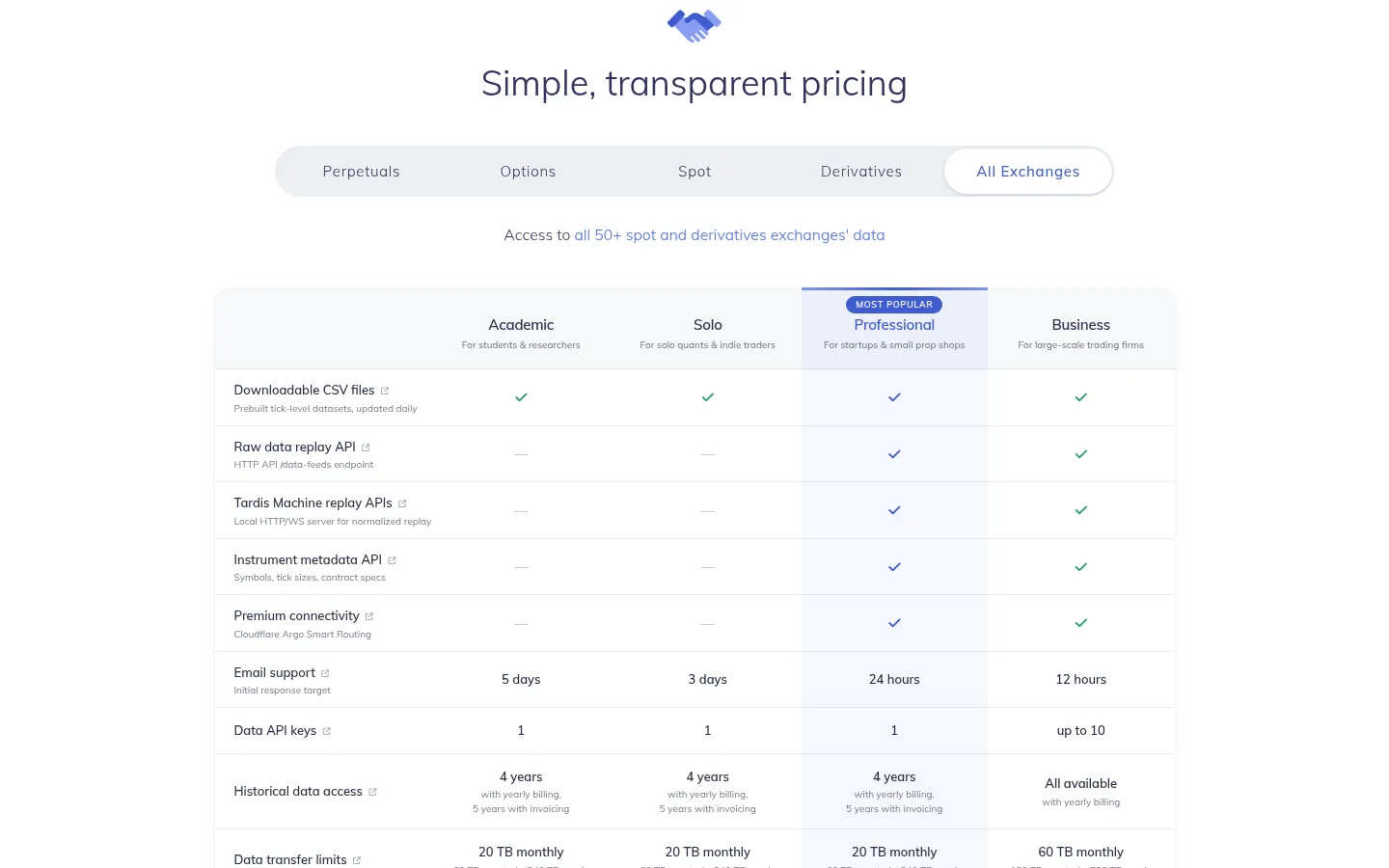
- Subscriptions are monthly and start at $350 (academic) or $700 (solo) for one package; the order form sets a $300 minimum and the vendor offers no discounts and no refunds.
- Solo and Academic plans get CSV files only; the replay API and Tardis Machine need Professional or Business.
- How far back you can download depends on billing: 4 months on monthly, 12 months on quarterly, 4 years on yearly; only Business gets all history.
- No SLA and no phone support, email only. Redistributing or reselling the data, or building a feed or backtesting product on it, is not allowed.
Latest news
Screens
Pricing
Flat monthly subscription per data package (Perpetuals, Options, Spot, Derivatives, All Exchanges); billed monthly, quarterly or yearly; history depth depends on billing interval; minimum order $300; no discounts, no refunds. Free use: Yes (First day of every month free for all exchanges and data types (no key); plus a one-off trial: days 1-10 of the previous month, 20 GB transfer, no card). Prices as listed on 21 Nov 2026.
What you get
Tick-level history
Every trade and order book update is captured from exchange WebSocket feeds, with timestamps to 100 ns at receipt.
Order book data
Incremental L2 updates, top-25 and top-5 snapshots, and market-by-order L3 where the exchange offers it (Coinbase Exchange is the example).
Derivatives data
Funding rates, open interest, mark and index prices, liquidations, and options chains for several exchanges.
CSV downloads
Daily gzipped CSV files per exchange, symbol and data type, available the next day around 05:00 UTC.
Replay API
An HTTP /data-feeds endpoint returns exchange-native NDJSON in 1 to 10 minute slices; the newest data is about 6 minutes old.
Tardis Machine
Open-source local server that replays history over WebSocket as if it were the live exchange, with normalised data and custom snapshot intervals.
Normalised messages
Client libraries and Tardis Machine convert exchange formats to one shape: trades, book changes, snapshots at tick/10ms/100ms/1s/10s, quotes, OHLCV and trade bars.
Free real-time clients
Open-source libraries stream live data straight from exchanges with no API key; there is no hosted real-time API.
Data coverage
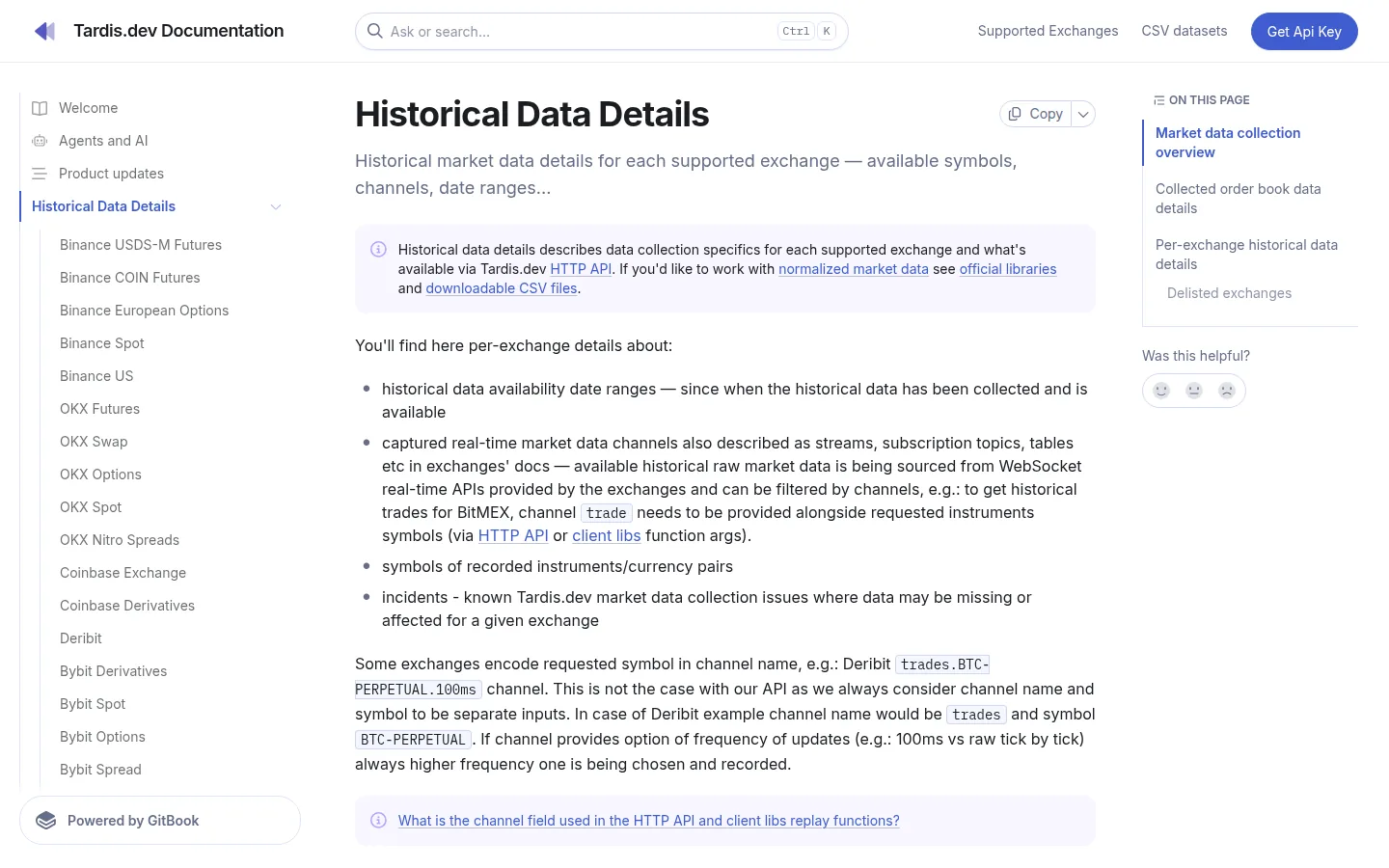
50+ exchanges (58 active exchange entries in the docs index); earliest data 30 Mar 2019; later start dates per exchange
Works with
History
Trader reviews
How we score →No reviews on Fintech Rankings yet. Be the first: we read every review before it appears.
Write the first reviewSimilar tools
All data and devtools →Questions
How much does Tardis.dev cost?
Plans run per data package from $350/month (Academic, Perpetuals or Options) to $6,000/month (Business, All Exchanges), with a $300 minimum order and no discounts.
Can I use it for free?
Yes, in a limited way: the first day of every month is free for all exchanges and data types without an API key, and there is a one-off trial of days 1-10 of the previous month with 20 GB of transfer.
Which markets and exchanges does it cover?
Crypto spot, perpetuals, futures and options on 50+ exchanges including Binance, OKX, Bybit, Deribit, Coinbase, Kraken, Hyperliquid and Lighter, plus Polymarket. The docs list 58 active exchange entries.
How far back does history go?
The earliest data is from 30 Mar 2019, but each exchange starts at its own date and your plan limits access: 4 years on yearly billing, 12 months quarterly, 4 months monthly; Business gets all history.
Is it live data or historical data?
Mainly historical: CSV files arrive the next day around 05:00 UTC and the replay API is about 6 minutes behind. Live streaming comes from free open-source clients that connect directly to exchanges; there is no hosted real-time API.
Can I redistribute or resell the data?
No. Internal business, research, education and personal use are allowed, and you may share charts, research and OHLCV candles of 10 minutes or longer, but you cannot offer a feed, API or backtesting platform built on it.